
This case study is protected under an NDA. Confidential and proprietary details have been removed or anonymized to protect client information. For more information, please contact godhani25shreya@gmail.com
Role
Lead UX Design and Researcher
Industry
Enterprise Technology
Timeline
Jan - May 2026
Tools
Figma
Outcome
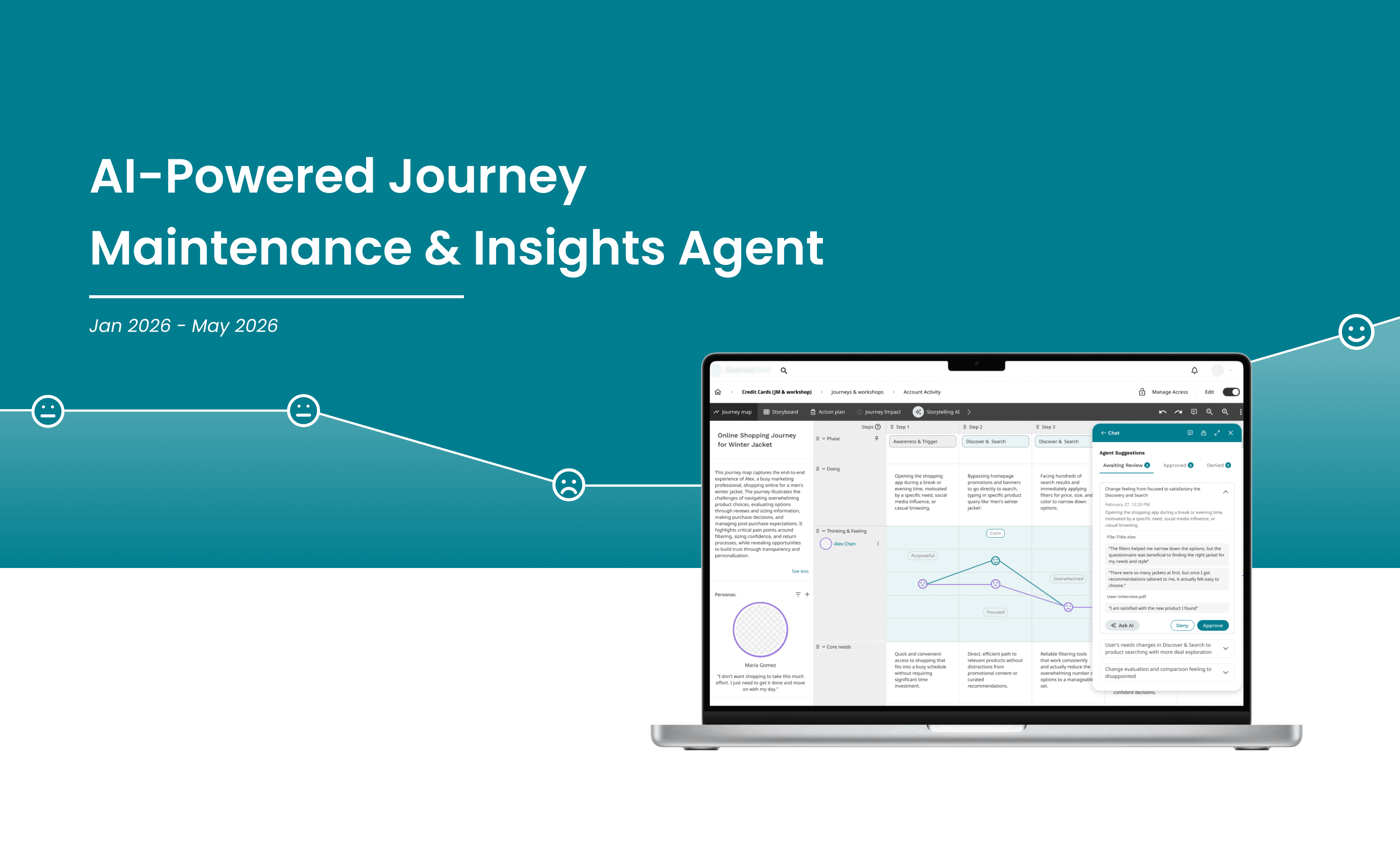
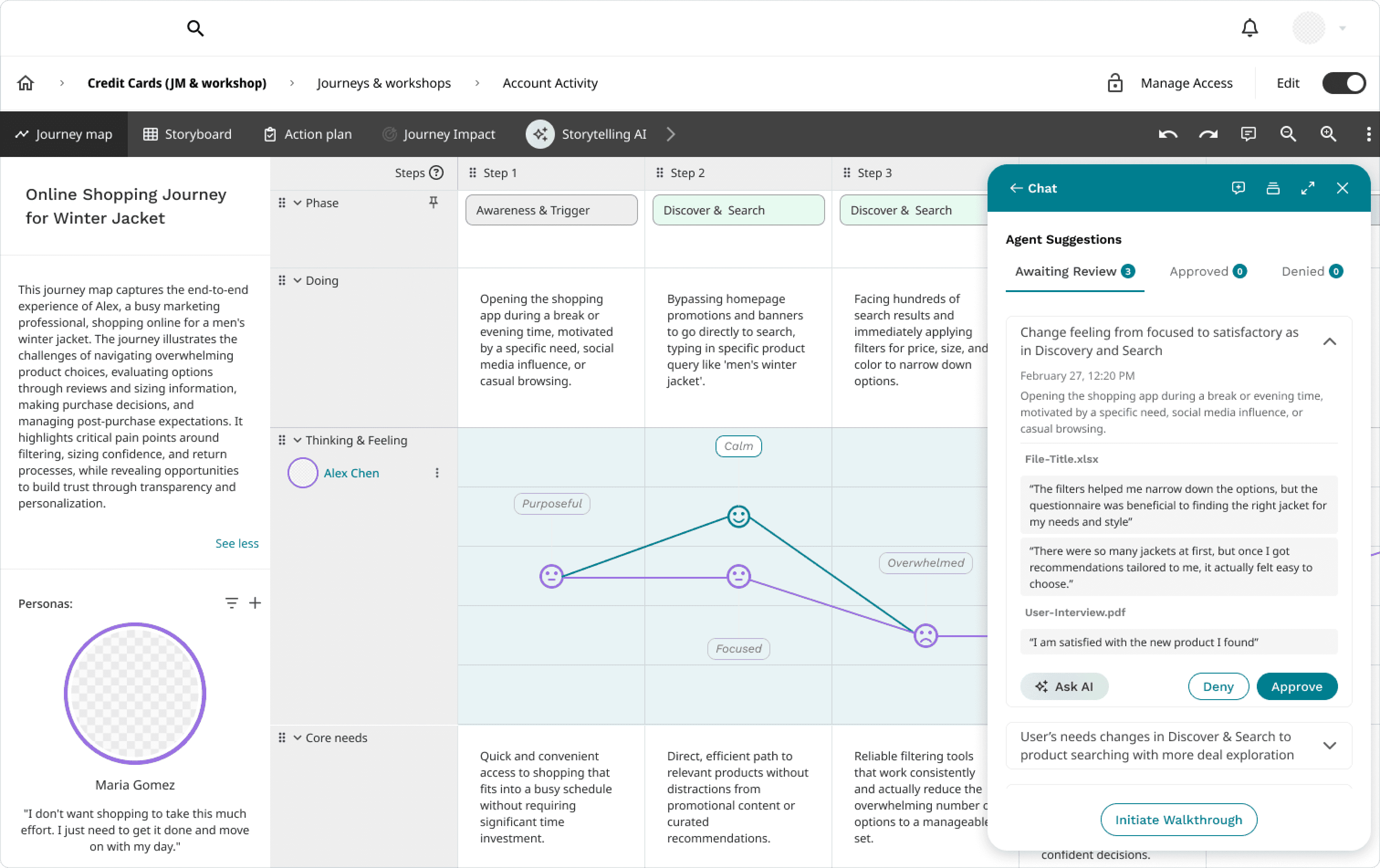
Led a team in building an AI-powered intelligence agent that proactively identifies outdated data and suggests updates, while reactively assisting users in modifying content.
The solution was visualized within the existing platform and design system, demonstrating how the maintenance agent would integrate into users' existing workflows.
My Impact
As the senior member of a nine-person team, I led project direction, AI strategy exploration, and research synthesis while mentoring teammates who were newer to UX.
I led or heavily contributed to:
Defining the project roadmap and research strategy
Conducting generative research on AI systems and trust design
Structuring the competitive analysis framework
Leading and guiding interaction pattern analysis methods
Conducting user interviews and mentoring junior researchers
Synthesizing research findings into product direction
Originating the proactive AI maintenance concept
Designing major portions of the high-fidelity prototype

Discovery and Research
We began by understanding how teams currently maintained journey maps, where workflows broke down, and how AI could support maintenance without removing user control.
Within this phase we conducted:
Generative Research
Competitive & Interaction Pattern Analysis
User Interviews
This sequence helped us move from understanding the broader AI and journey-mapping landscape to validating real user behaviors, frustrations, and trust concerns.
Generative Research
Teams using journey mapping tools rely on reactive maintenance, creating an opportunity for proactive flows
Types of AI
Generative research revealed two different types of AI:
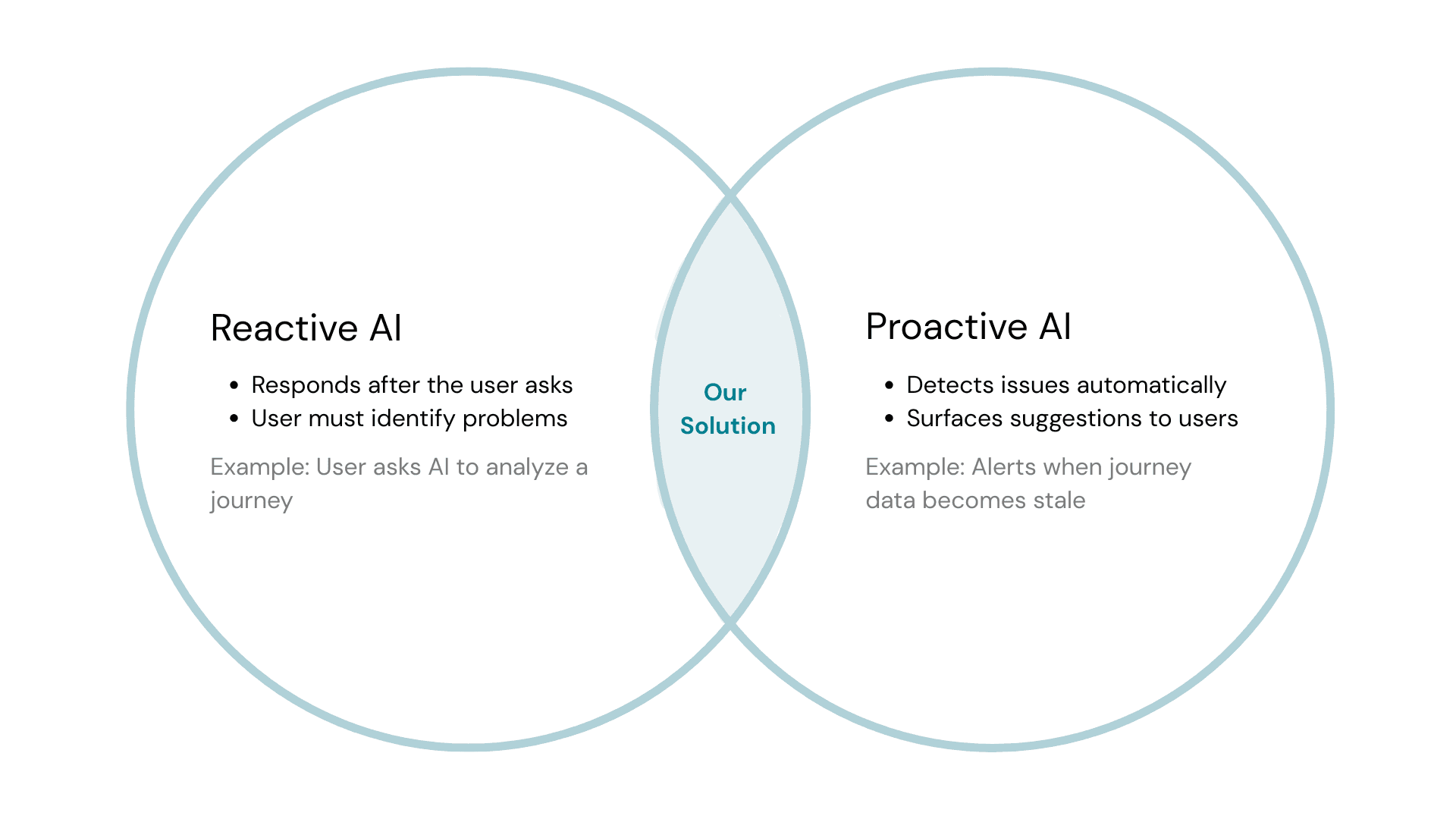
The teams we interviewed updated journey maps reactively, meaning they would only update a journey map when someone noticed a gap.

Key Opportunity
This created an opportunity for proactive AI to monitor for staleness before users even realize there's a problem.
Proactive AI Best Practices
I also explored how AI systems build user trust and support decision-making.
This research revealed two requirements for trustworthy AI assistance:

Explain the reasoning behind recommendations
Keep users in control of decisions
Key Design Decision Influenced by Research
AI should support decision-making, not replace it.
Competitive & Interaction Pattern Analysis
Competitors use proactive AI monitoring, but most tools still rely on manual triggers
We evaluated competitive journey mapping platforms and adjacent SaaS products to understand how teams currently handle verification, monitoring, and surface AI-generated insights.
Most systems surfaced reminders based on time intervals rather than behavioral or contextual changes.
We also found several recurring usability gaps:
Verification states were difficult to discover
Evidence was hidden behind multiple interactions
Users lacked comparison and undo visibility
AI suggestions often appeared disconnected from workflow context
These findings directly influenced our design decisions.
Key Design Decisions Influenced by Research
Surface AI suggestions directly inside the journey workflow
Attach evidence to every recommendation
Preserve user control through approval and comparison flows
User Interviews
Maintenance is manual, disconnected, and operationally heavy, but users still want to stay close to the data
Through 6 user interviews, we aimed to understand how users decide when a journey needs updating. After interviewing and affinity diagraming, I found that
Maintenance is manual and reactive, not proactive
Upon manual review, updates are triggered by noticeable events including product changes, customer complaints, or new roles rather than continuous monitoring.

No system for detecting stale content
Teams rely on intuition, journey age, or stakeholder gut-checks. Journeys older than 1 year lose internal credibility.

Trust and transparency for AI integration
AI outputs must be accurate and defensible. Participants didn't want full automation, as they would want to understand data and reasoning.
These findings gave us clear direction heading into ideation, shifting our focus toward both proactive and reactive maintenance and building trust into AI features by finding the balance between automated and manual work.
Ideation and Concept Proposal
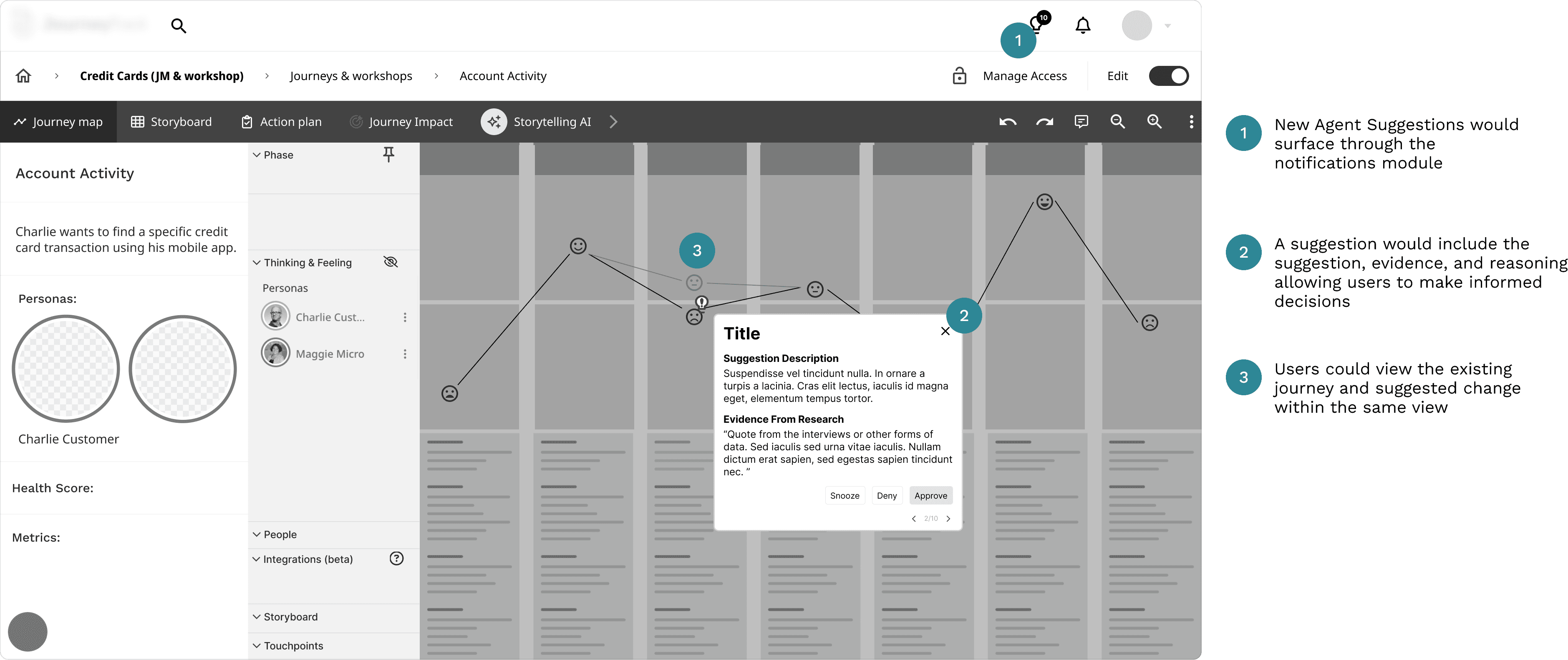
Our early ideation explored multiple AI-assisted maintenance concepts, but two directions emerged as the strongest considering user and business goals:
Proposal A
Proactive Insights
An AI system that continuously monitored connected data and surfaced contextual recommendations when journey content appeared outdated.
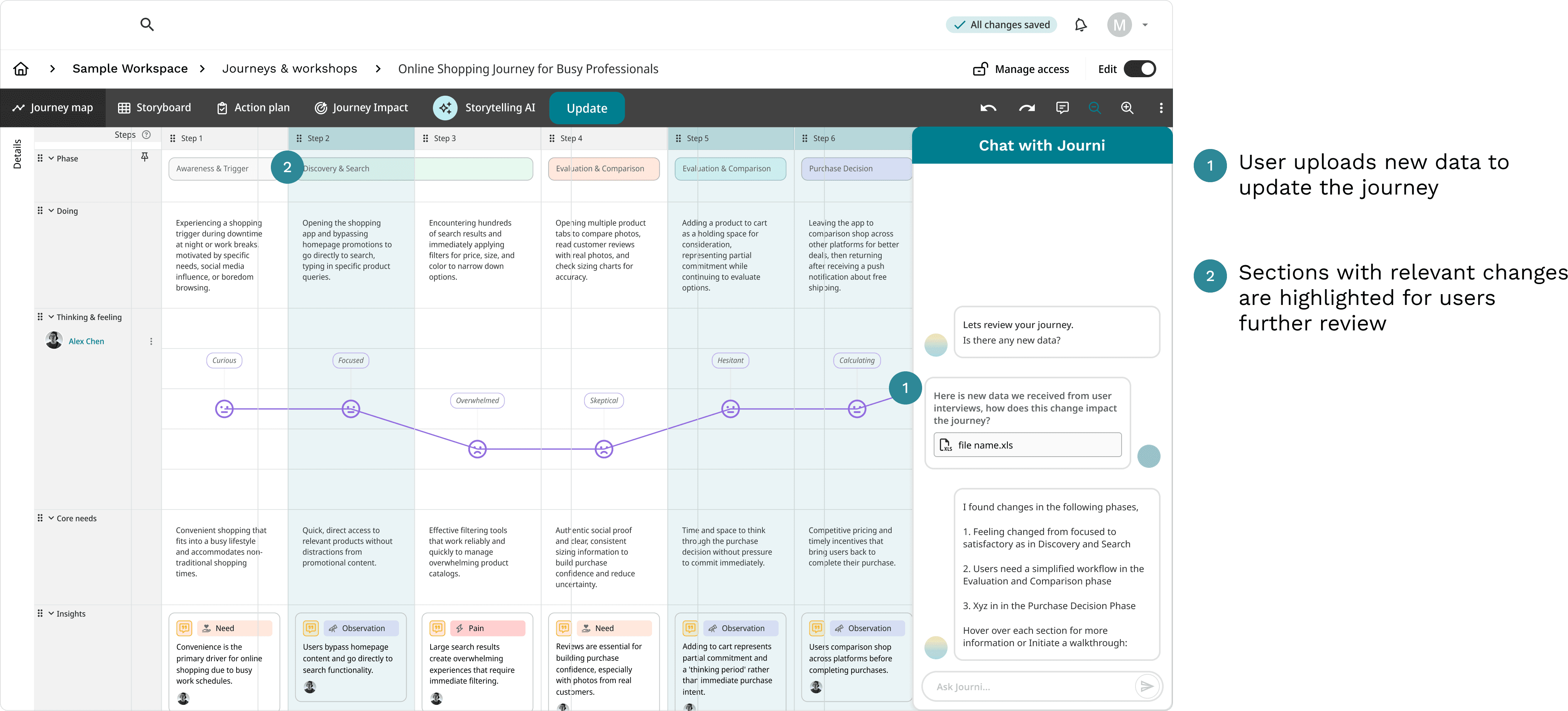
Proposal B
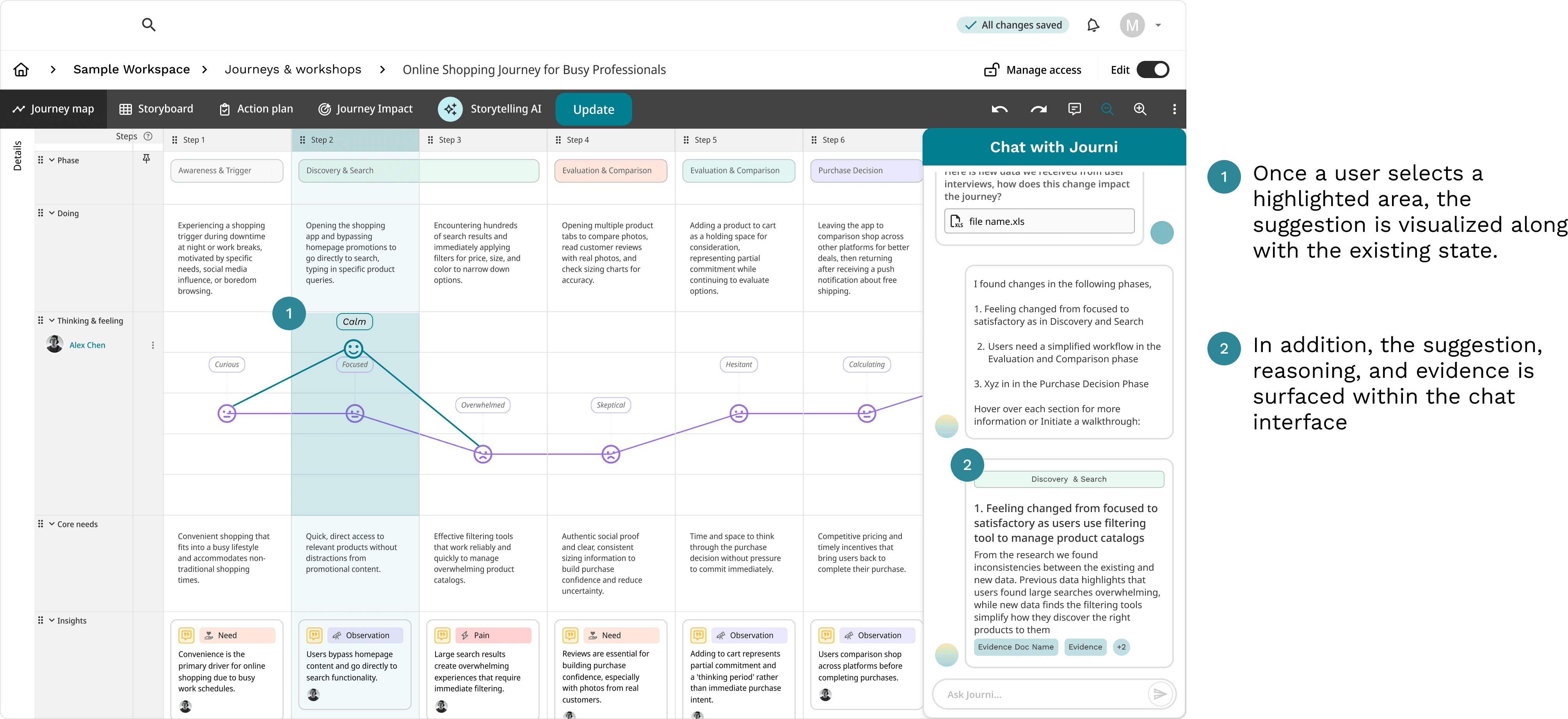
Reactive Guided Journey Updating
The reactive AI workflow allows users to upload new information and receive step-by-step assistance updating journey content.
The assistant then guided users through:
Identifying affected content
Understanding recommended changes
Updating journey sections step-by-step
Initially, these existed as separate concepts.
As we explored the workflows further, we recognized both systems relied on the same:
Evidence model
Recommendation logic
Decision-making patterns
AI assistant architecture
Rather than maintaining two fragmented experiences, we merged them into a unified AI maintenance system.
This became a major turning point in the project.
Designing a Unified System
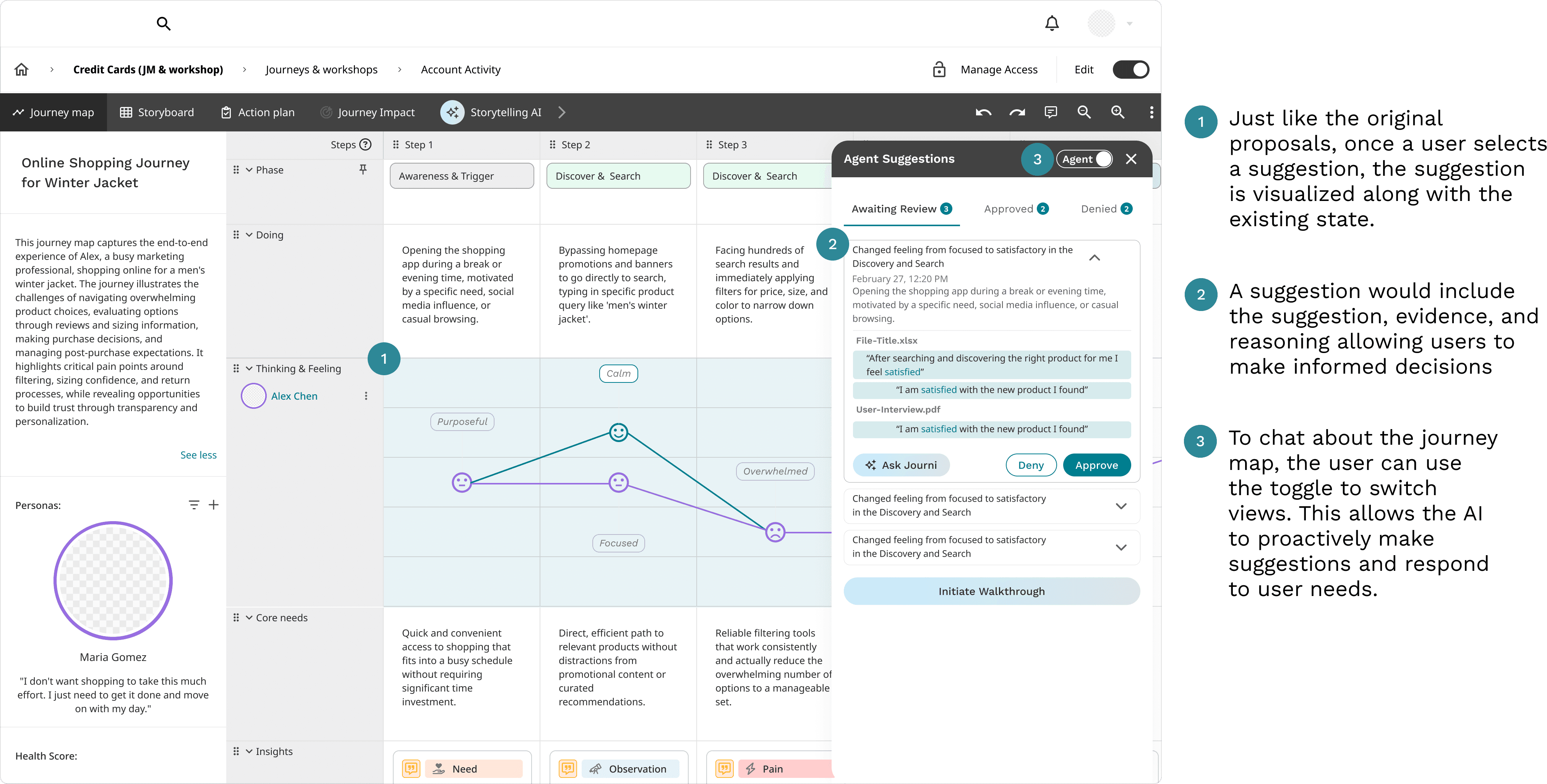
The final experience combined proactive monitoring and reactive assistance into a single AI assistant panel.
With this new system, I tested it to ensure usability and intuitiveness.
Usability Testing
Participants found the prototype intuitive, but evidence interactions and AI disambiguation needed refinement
We tested the prototype with six UX designers or participants familiar with journey mapping instead of platform users.
Participants completed tasks involving:
Reviewing AI suggestions
Evaluating evidence
Navigating between recommendations and assistant interactions
Initiating guided update flows
What worked

General positive reception to the prototype's simplicity
The average difficulty rating across task completion was 3 out of 10.
Evidence transparency was valued
Users appreciated being able to trace suggestions back to source documents, citing it as a key trust signal.
What needed refinement

Evidence interactions weren't obvious
To improve discoverability, we
Added clearer hover states
Strengthened visual affordances
Introduced motion cues aligned with the design system
Moving between suggestions and the chatbot was unituitive
We simplified navigation and more tightly integrated the assistant into the recommendation workflow.
This reduced friction and created a more cohesive experience.
Final Outcome
The final design demonstrated how AI could support enterprise journey maintenance without removing human oversight.
Instead of automating decisions entirely, the system focused on:
Surfacing contextual insights
Supporting informed decision-making
Increasing visibility into outdated content
Reducing manual maintenance effort
Building trust through transparency and evidence
By combining proactive monitoring and reactive guidance into one unified system, the experience reduced fragmentation while supporting multiple user workflows.
Proactive Flow
The agent surfaces suggestions automatically
Reactive Flow
The user uploads new research or data for the Intelligence Agent to generate suggestions.
Reflection
This project strengthened my understanding of designing AI-assisted enterprise workflows where clarity and trust are critical.
One of the biggest challenges was balancing information density with usability. Customer success platforms naturally contain large volumes of data, but surfacing everything equally creates cognitive overload and reduces decision-making efficiency.
I also gained a deeper insight for how to design trustworthy AI interactions. Recommendations became more trusted when paired with supporting evidence and contextual reasoning rather than hiding the AI's process and thinking.
